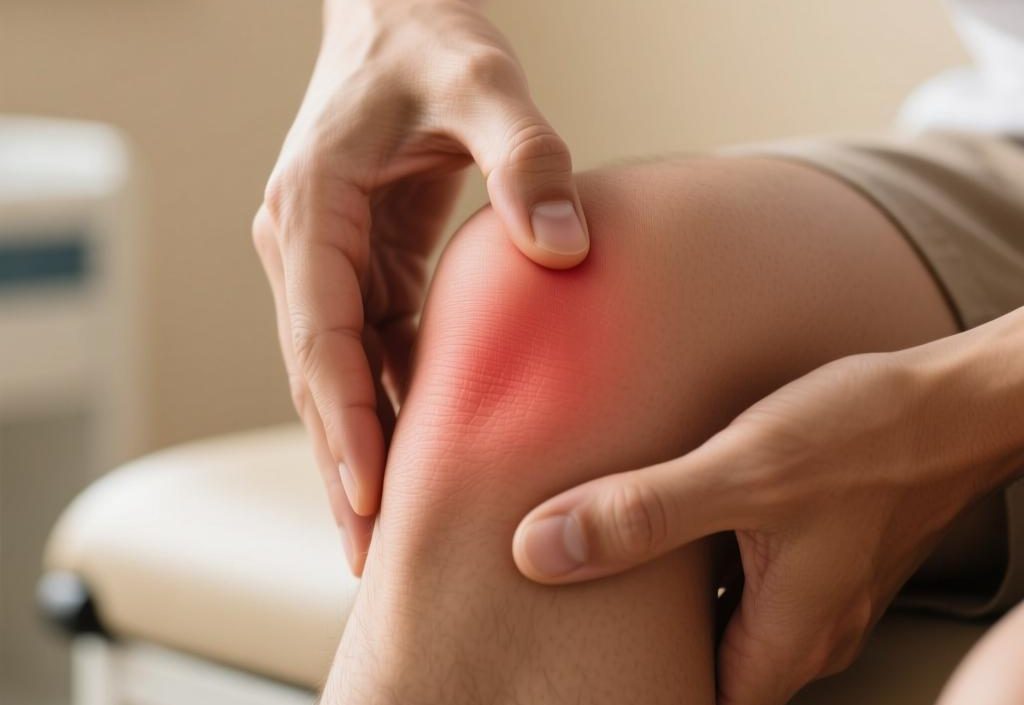
Knee pain is one of those things almost everyone deals with at some point. Maybe you noticed it climbing stairs, or when you stood up from the couch and felt a dull ache. Maybe it showed up after a weekend of gardening, or maybe it crept in slowly over months with no obvious reason at all.
I see patients every week who are surprised to learn that knee pain isn’t always about the knee itself. Sometimes it’s a signal from your hormones, your bones, your metabolism, or the medication you’re taking. So let’s walk through this together, figure out what might be behind your knee pain, and talk about when it’s time to get checked out.
What’s Actually Inside Your Knee?
Before we talk about pain, it helps to picture what we’re working with. Your knee is the largest joint in your body, and it’s essentially a hinge that also does a bit of rotation. It carries almost your entire body weight with every step you take, and far more when you climb stairs or squat down.
- Bones: The thigh bone (femur), the shin bone (tibia), and the kneecap (patella) all meet here.
- Cartilage: A slick cushion covering the bone ends so they glide smoothly against each other.
- Menisci: Two C-shaped wedges of cartilage that act as shock absorbers between the bones.
- Ligaments and tendons: Straps and cables that hold everything together and connect muscles to bone.
- Synovium: A thin lining that makes fluid to lubricate the whole system.
When everything works, you barely notice your knees. When any one of these parts gets irritated, worn, inflamed, or damaged, you definitely notice. The tricky part is that different structures produce different kinds of pain, and pain from other parts of your body, like your hips or your spine, can even travel to your knee. That’s why detective work matters.
The Most Common Culprits Behind Knee Pain
Most knee pain falls into a few familiar buckets. Here’s a quick overview of the usual suspects before we dig into the hormone and metabolism connections that people often miss.
| Possible Cause | How It Typically Feels | Common Triggers |
|---|---|---|
| Osteoarthritis | Aching and stiffness that’s worse in the morning or after activity, gradual onset | Aging, past injuries, extra weight |
| Tendonitis | Sharp pain just below or above the kneecap | Running, jumping, repetitive movement |
| Meniscus tear | Catching, locking, or a popping sensation with localized pain | Twisting on a bent knee |
| Ligament injury | Sudden instability, the knee “gives way” | Sports, falls, accidents |
| Bursitis | Swelling and tenderness at the front of the knee | Kneeling, repetitive pressure |
| Gout or pseudogout | Intense redness, swelling, and pain that wakes you at night | Uric acid or calcium crystal buildup |
If your pain came on suddenly after a specific twist, fall, or sports move, an injury is the likely explanation, and that’s worth evaluating fairly quickly. But if your pain arrived gradually and sticks around, that’s where the endocrine story gets interesting.
Could Your Hormones Be Talking to Your Knees?
This is the part people rarely hear about. Your hormones quietly influence your joints in ways you might never connect to knee pain.
Estrogen, for example, isn’t just a reproductive hormone. It helps maintain bone density and has anti-inflammatory effects on joints. During perimenopause and menopause, estrogen levels drop, and many women notice new joint aches or stiffness right alongside hot flashes and sleep changes.
Research also suggests that lower estrogen may contribute to the development of osteoarthritis in women after menopause. If you’re a woman in your forties or fifties and your knees started aching along with a changing cycle, that timing may not be a coincidence.
Thyroid disorders are another sneaky cause. An underactive thyroid (hypothyroidism) can cause general muscle and joint aches, fluid retention that puffs up joints, and slow healing.
Some people with untreated hypothyroidism describe a deep, unexplained stiffness in their knees and hips. An overactive thyroid can accelerate bone loss, which sets the stage for other problems down the road.
And then there’s cortisol, your main stress hormone. Both naturally high cortisol (think chronic stress) and conditions like Cushing’s syndrome, or the long-term use of corticosteroid medications like prednisone, can thin your bones and weaken the blood supply to bone tissue.
In rare cases, that leads to a condition called osteonecrosis, where bone tissue in the knee or hip literally starts to break down. If you’ve been on steroids for months or years and develop new knee pain, mention it to your doctor, because it needs specific imaging to catch.
Weak Bones, Osteoporosis, and Stress Fractures
When most people think of osteoporosis, they picture hip fractures in older adults. But bone loss affects more than the hip and spine, and it often gives no warning before something cracks. A stress fracture, a tiny crack from repetitive load rather than a single trauma, can develop in the bones around the knee, particularly in the tibia or the top of the shin.
Stress fractures around the knee feel like a localized pain that gets worse with weight-bearing and improves with rest. They’re more common in people with low bone density, long-distance runners who ramped up training too fast, and anyone with a vitamin D or calcium deficiency.
This matters because a stress fracture that’s ignored can turn into a complete fracture, so persistent pinpoint pain deserves an X-ray or MRI.
- Postmenopausal women are at the highest risk of osteoporosis-related fractures.
- Long-term steroid use, low body weight, smoking, and heavy alcohol all accelerate bone loss.
- Vitamin D deficiency is extremely common and often silent until bones start complaining.
- A bone density scan (DEXA) is quick, painless, and the standard way to measure bone strength.
Metabolism, Weight, and the Load on Your Joints
Here’s a number that surprises most of my patients: every extra pound of body weight puts roughly four pounds of pressure on your knees when you walk. Going up stairs? The multiplier climbs even higher. So ten extra pounds can mean forty extra pounds of force on your knee joints with every single step, thousands of times a day.
But it’s not only mechanical load. Body fat is metabolically active tissue that produces inflammatory chemicals called cytokines. These circulate through your body and can worsen inflammation inside your joints, which is why obesity is now understood as an independent risk factor for osteoarthritis, not just a matter of wear and tear.
The good news runs both ways: losing even five to ten percent of your body weight can meaningfully reduce knee pain and slow joint damage.
Type 2 diabetes deserves special mention too. People with diabetes have higher rates of osteoarthritis, tendinopathy, and a puzzling condition called diabetic cheiroarthropathy that causes joint stiffness.
Poorly controlled blood sugar also accelerates tissue inflammation throughout the body, including in joints. If you have diabetes and new knee pain, tight glucose control should be part of your joint treatment plan, not an afterthought.
Crystal Arthritis: When Your Metabolism Leaves Deposits
Two metabolic conditions deposit crystals inside joints, and the knee is a favorite target for both.
Gout happens when uric acid builds up in your blood and forms needle-like crystals in the joint. The classic gout attack strikes the big toe, but the knee is a very common location too. It typically arrives like a bolt of lightning: your knee becomes red, hot, swollen, and exquisitely painful, sometimes overnight.
Attacks are linked to diet (red meat, organ meat, alcohol, sugary drinks), dehydration, certain medications like diuretics, kidney problems, and metabolic factors like obesity and insulin resistance. Recurrent attacks can damage the joint permanently, so if this sounds familiar, a simple blood test and proper treatment can prevent a lot of grief.
Pseudogout is its lesser-known cousin, caused by calcium pyrophosphate crystals. It mimics gout almost exactly and becomes more common with age, thyroid problems, hemochromatosis (iron overload), and parathyroid disorders. Interestingly, several conditions that cause pseudogout are themselves endocrine diseases, which is exactly why an endocrinologist often ends up in the picture when this diagnosis appears.
Vitamin D: The Overlooked Player
I check vitamin D levels on a huge share of my patients with unexplained aches, and deficiency is remarkably common. Severe vitamin D deficiency in adults causes osteomalacia, which literally means “soft bones.”
The hallmark is diffuse bone pain and muscle weakness, often affecting the hips, pelvis, lower back, and knees. Many patients describe it as a vague, hard-to-pin-down ache that made them cut back on activity without knowing why.
Risk factors include limited sun exposure, darker skin, older age, obesity (vitamin D gets stored in fat tissue), and malabsorption conditions. A simple blood test tells us where you stand, and correction is usually straightforward with supplementation and monitoring.
If your knees ache and you feel generally weaker or wobblier than you used to, it’s worth asking for that test rather than guessing with high-dose supplements on your own.
Simple Ways to Give Your Knees a Fighting Chance
Whatever the underlying cause, nearly every knee benefits from the same basic support system. You don’t need to become a gym devotee; you need consistency.
- Strengthen your thighs: Strong quadriceps and hamstrings act like a built-in brace for your knee. Straight-leg raises, wall sits, and gentle squats are a good start.
- Choose joint-friendly movement: Swimming, cycling, and walking on level ground keep joints lubricated without hammering them.
- Keep your weight in a comfortable range: Even modest loss pays real dividends for knee comfort.
- Wear supportive shoes: Good footwear and cushioned soles absorb shock before it reaches your knees.
- Warm up before activity: Cold muscles and tendons are grumpy muscles and tendons.
- Don’t ignore persistent pain: Pushing through pain for weeks usually turns a small problem into a bigger one.
When Should You Actually See a Doctor?
Not every twinge needs an appointment. But some signs mean you should stop waiting it out. Seek medical care if you notice any of the following.
- Your knee is visibly deformed, or you can’t put weight on it at all.
- There’s significant swelling, redness, or warmth, especially if you also have a fever.
- The pain followed a major injury, like a fall or twisting accident.
- Your knee locks, catches, or gives way underneath you.
- Pain has lasted more than six weeks despite rest.
- You have night pain that wakes you from sleep.
- You also feel unexplained weight loss, fatigue, or whole-body symptoms.
A few of those symptoms overlap with infection and inflammatory conditions that need prompt treatment, so when in doubt, get looked at sooner rather than later.
What Kind of Testing Can You Expect?
Doctor visits for knee pain usually start simple: a careful history and a hands-on exam tell us a great deal. From there, the workup branches depending on the story. Plain X-rays show arthritis, fractures, and bone alignment.
Ultrasound and MRI reveal soft tissue like menisci, tendons, and swelling. Blood tests can check inflammation markers, uric acid, thyroid function, vitamin D, blood sugar, and hormones. If joint fluid is drawn with a needle, it can be examined under a microscope for crystals, infection, or inflammation.
My advice: don’t walk in asking for an MRI. Walk in ready to describe the details, because they genuinely steer the diagnosis. Think about when the pain started, what makes it better or worse, whether it swells, whether it’s stiff in the morning and for how long, and whether anything else in your body feels different lately.
FAQs
Why do my knees hurt more in cold or damp weather?
The honest answer is we’re not entirely sure. Studies suggest changes in barometric pressure may cause tissues around the joint to expand slightly, which can irritate nerve endings.
What we do know is that weather-related pain is very real for many people with arthritis, but it doesn’t signal new damage. Staying warm, staying active indoors, and keeping joints moving on gloomy days usually helps.
Can knee pain be a sign of something serious?
Occasionally, yes. A septic joint infection, an inflammatory arthritis, certain tumors, and vascular problems can all present as knee pain. Warning flags include fever with a hot swollen joint, night pain that’s unaffected by position, rapid unexplained weight loss, or pain that steadily worsens over weeks. Those deserve prompt evaluation.
Do hormones really affect joints, or is that a myth?
It’s real. Many women report new joint aches during perimenopause and menopause, and studies support a link between falling estrogen and joint pain and stiffness. Thyroid problems, excess cortisol, and growth hormone disorders can all affect joints and bones too. If joint pain arrived alongside other hormonal changes, an endocrine evaluation can be worthwhile.
Is walking bad for arthritic knees?
On the contrary, walking is usually one of the best things for them. Cartilage has no blood supply of its own; it gets nourished by movement, which circulates joint fluid. People with arthritis who walk regularly typically report less pain over time, not more. The key is sensible pacing, supportive shoes, and flat or gentle terrain.
When should knee pain send me to the emergency room?
Go urgently if you can’t bear any weight, your knee looks deformed after an injury, you have a fever with a hot and swollen joint, or you suspect a serious break. These situations can involve fractures, infections, or unstable injuries where hours matter.
Can losing weight really fix my knee pain?
“Fix” is a strong word, but studies consistently show that losing five to ten percent of body weight reduces knee pain substantially and improves function in people with knee osteoarthritis. Combined with strengthening exercises, weight management is one of the most evidence-backed treatments we have, more effective for many people than any single pill.
Knee pain is a message, not a sentence. Sometimes the message is “ease up on the running,” sometimes it’s “your bones need support,” and sometimes it’s “your metabolism or hormones need attention.”
Pay attention to the clues, give your knees the daily care they deserve, and bring stubborn pain to a professional who will look at the whole picture, not just the joint. Your knees have carried you this far; with the right care, they’ll keep carrying you a lot further.