
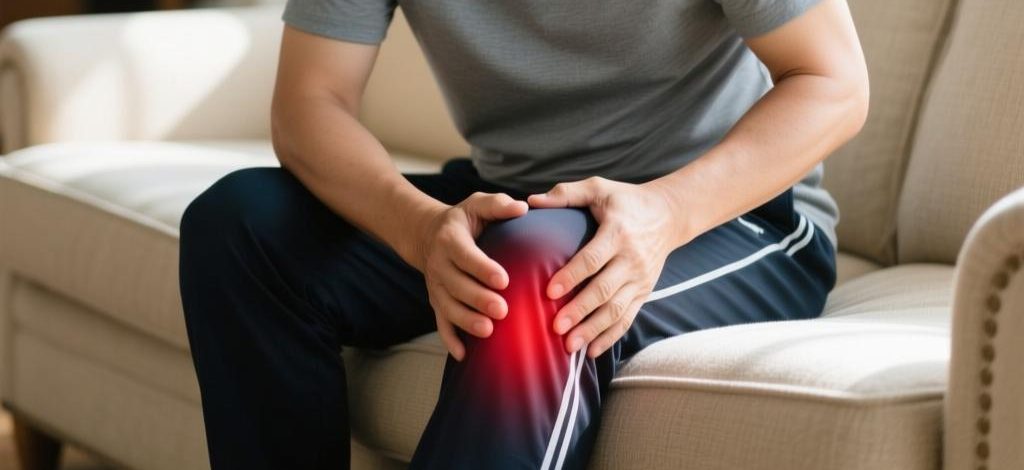
Why Rest Can Actually Make Joint Pain Worse
When your joints hurt, the instinct to curl up on the couch and wait it out is completely understandable. I hear it almost every day in my exam room: “Doctor, I stopped walking because my knee complains every time I do.” Here is the twist most people never hear — that well-meaning rest is often the very thing keeping you stuck in pain.
Joints are built around a simple design principle: they are meant to move. Inside every healthy joint sits synovial fluid, a slippery, nourishing liquid that bathes the cartilage and keeps surfaces gliding smoothly.
That fluid gets pushed around when the joint moves, which is how cartilage — a tissue with no direct blood supply — gets its oxygen and nutrients. Stay still for too long and that delivery service slows to a crawl. Cartilage thins, muscles shrink, and the stiffness you feel in the morning starts sticking around for the whole afternoon.
Within just a few days of bed rest, healthy adults can lose a surprising amount of muscle strength, and the muscles that cross a painful joint are the very ones protecting it. Weak muscles mean less shock absorption, less stability, and more load landing directly on an already irritated joint.
So the cycle feeds itself: pain leads to rest, rest leads to weakness, weakness leads to more pain. Breaking that loop — gently and deliberately — is the whole point of this article.
How Movement Actually Helps Your Joints
Let me clear something up right away: motion does not “wear out” your joints like a car part. Study after study shows that recreational runners, for example, do not develop knee arthritis at higher rates than people who sit all day — in many cases, their knees actually fare better. Used correctly, movement is joint medicine, and there are several reasons why.
First, consistent activity improves circulation and keeps synovial fluid flowing, which nourishes cartilage and helps it stay thick and resilient. Second, exercise strengthens the muscles around the joint, so your thighs, hips, and core absorb the impact your knees and hips would otherwise take alone.
Third, movement is one of the most reliable natural pain relievers we know of — it releases endorphins, the body’s own feel-good chemicals, which dampen pain signals and lift mood at the same time. Fourth, regular motion helps control systemic inflammation, which matters enormously for anyone dealing with arthritis pain or other inflammatory conditions.
There is also a less talked-about benefit: confidence. Pain teaches your brain to guard a joint, and that guarding becomes a habit. Controlled, progressive movement retrains your brain to trust the joint again, and that trust is often the difference between limping through life and living fully again.
The Best Low-Impact Exercises for Sore Joints
Not all exercise is created equal when your joints are grumbling. The goal is to load them enough to strengthen, but not so much that you inflame them. Below are my favorite starting points, ranked from gentlest to most challenging.
| Exercise | Why It Works | How to Start |
|---|---|---|
| Walking | Weight-bearing but gentle; lubricates joints and lifts mood | 10 minutes on flat ground, add 5 minutes weekly |
| Water aerobics or swimming | Buoyancy removes most joint load while building strength | One 30-minute class weekly |
| Stationary cycling | Smooth, controlled knee and hip motion with no impact | 10–15 minutes at an easy resistance |
| Yoga or tai chi | Improves flexibility, balance, and joint position sense | A beginner class or 15-minute video |
| Elliptical machine | Mimics running without the pounding | 10 minutes at a conversational pace |
If your knees hurt specifically, water exercise and cycling usually earn the first prescription in my office. If it is your back or hips complaining, swimming and tai chi tend to be the kindest entry points. Pick one you genuinely enjoy — enjoyment is the single best predictor of whether you will still be doing it in three months.
Easy Ways to Start When Everything Already Hurts
Starting is the hardest part, so make it almost embarrassingly easy. Here is the advice I give my own patients:
- Use the two-minute rule — commit to just two minutes of movement. Once you start, continuing is easy; the starting is the hard part.
- Break activity into snacks — three 10-minute walks spread through the day count just as much as one 30-minute session.
- Warm up before you move — five minutes of slow marching or a warm shower loosens stiff joints and makes movement far more comfortable.
- Move at your golden hour — most people with arthritis feel best mid-morning; schedule activity then, not first thing out of bed.
- Choose flat, predictable terrain at first — save hills and trails for when you are stronger.
- Dress the part — supportive cushioned shoes are cheap joint insurance.
- Track something other than pain — minutes moved, stairs climbed, or laps swum. Pain fluctuates; progress deserves its own scoreboard.
Consistency beats intensity every single time. A modest daily walk will outperform a heroic weekend hike followed by four days of limping.

Strength Training: Your Joints’ Best Friend
If I could prescribe only one long-term intervention for achy knees, hips, or shoulders, it would be progressive strength training. Strong muscles are living shock absorbers.
Every pound of force your quads and glutes can handle is force that never reaches the joint surface. Research on knee arthritis has shown that properly designed strengthening programs can reduce pain and improve function as much as some medications — without a single prescription.
You do not need a gym or heavy iron. Bodyweight sit-to-stands from a sturdy chair, wall squats within a pain-free range, glute bridges, and resistance band rows cover most of the bases. Two or three sessions a week is plenty.
The rule of thumb I give patients: some muscular effort is expected, but joint pain that lingers into the next morning means you scaled up too fast — drop back a level and build again slowly.
Funny enough, some of the same exercises that protect joints also improve circulation, energy, and even hormone balance, which is why fitness is often called the role of fitness in whole-body health rather than a knee-only project.
The Weight and Joint Pain Connection You Cannot Ignore
Here is a number worth memorizing: every pound of body weight puts roughly four pounds of pressure on your knees with every step you take — and up to ten pounds when climbing stairs. Carrying extra weight is like walking around with a backpack full of bricks strapped to your joints, all day, every day.
The good news cuts both ways. Losing even ten pounds removes about forty pounds of load per step from your knees. That is why movement is such a two-for-one deal: it strengthens joints directly while quietly trimming the load they carry.
Add sensible eating habits — an anti-inflammatory pattern like the gout diet approach of more plants, fish, and olive oil, less processed food — and the effect compounds.
And since joint-friendly weight loss also strengthens your heart, think of it as cardiovascular health purchased with the same daily walk. If getting started feels overwhelming, this guide on struggling with weight as you age offers a realistic first step.
Little Extras That Support the Work
Exercise does the heavy lifting, but a few supporting players deserve honorable mention. Some of my patients ask about supplements like collagen for joint support — the evidence is mixed but emerging, and it is generally safe to try. Others find that deep tissue therapy helps with sore feet and muscle tension that often accompany joint problems.
For stubborn cases, some patients explore chronic lower back pain options including CBD, and if you go that route, this roundup of CBD gummies for pain is a sensible place to compare products. Just remember: these are side dishes, not the main course. Movement, strength, and weight management remain the entrée.
When Running, Walking, and Everything Else Feels Impossible
Plenty of my patients love being active but feel betrayed by their bodies. Runners who develop sore knees do not need to hang up their shoes forever — they usually need better shoes, smarter training loads, stronger hips, and a short period of cross-training with cycling or swimming.
Swollen, puffy ankles after activity deserve attention too, since swollen feet often signal that a joint needs a different kind of support, not total shutdown. If boredom is your biggest obstacle, browsing fun workouts can turn exercise from a chore into something you actually look forward to.
Warning Signs That Mean Slow Down and Call Your Doctor
Movement should be uncomfortable at times — that is how growth works — but it should never be alarming. Stop and get evaluated if you notice any of the following:
- A joint that is hot, red, and dramatically swollen
- Pain that wakes you from sleep or steadily worsens over weeks
- Locking, catching, or giving way of the joint
- Numbness, tingling, or weakness in a limb
- Fever along with joint pain
- Pain following a significant fall or injury
None of these mean the end of an active life. They mean we need to figure out what is going on before you ramp up. Diagnoses are roadmaps, not verdicts.
Frequently Asked Questions
How long until I feel a difference from exercising?
Most people notice less stiffness within two to three weeks of consistent, gentle movement. Meaningful strength gains and lasting pain relief typically take six to twelve weeks. Think of it like tending a garden — nothing sprouts overnight, but everything you plant compounds.
Is it normal for joints to ache a little more when I start?
A mild, familiar ache during or shortly after new activity is common and usually fine, as long as it settles within a day and your joints feel no worse overall. Sharp pain, swelling, or pain that lingers into the next morning is your cue to scale back and reassess.
Walking hurts my knees — what should I do instead?
Start with water exercise or stationary cycling, which load the joints far less while building the strength that makes walking comfortable again. Once walking feels easier on level ground, gradually reintroduce it. There are also simple tips that work to ease your joint pain day to day while you rebuild.
Do I need to see a doctor before starting to exercise?
If your pain is mild and chronic, and you have no red-flag symptoms, a gradual start is generally safe. If you have heart conditions, significant arthritis, recent surgery, or unexplained pain, a quick check-in first is worth the appointment. My rule as a surgeon: I would much rather spend ten minutes clearing you than ten months repairing what went wrong.
Can exercise really help arthritis, or just cover up the pain?
It genuinely helps, not just masks. Strengthening reduces joint load, motion nourishes cartilage, and regular activity lowers inflammatory chemicals in the blood. Many arthritis patients reduce their reliance on pain medication after a few months of structured exercise — that is disease management, not a bandage.
What is the single best exercise for painful joints?
If I must choose one: walking in supportive shoes, on flat ground, at a pace where you could still hold a conversation. It is free, it is scalable, it strengthens nearly everything, and you can start today. Combined with two short strength sessions each week, it is a complete joint-care program hiding in plain sight.