
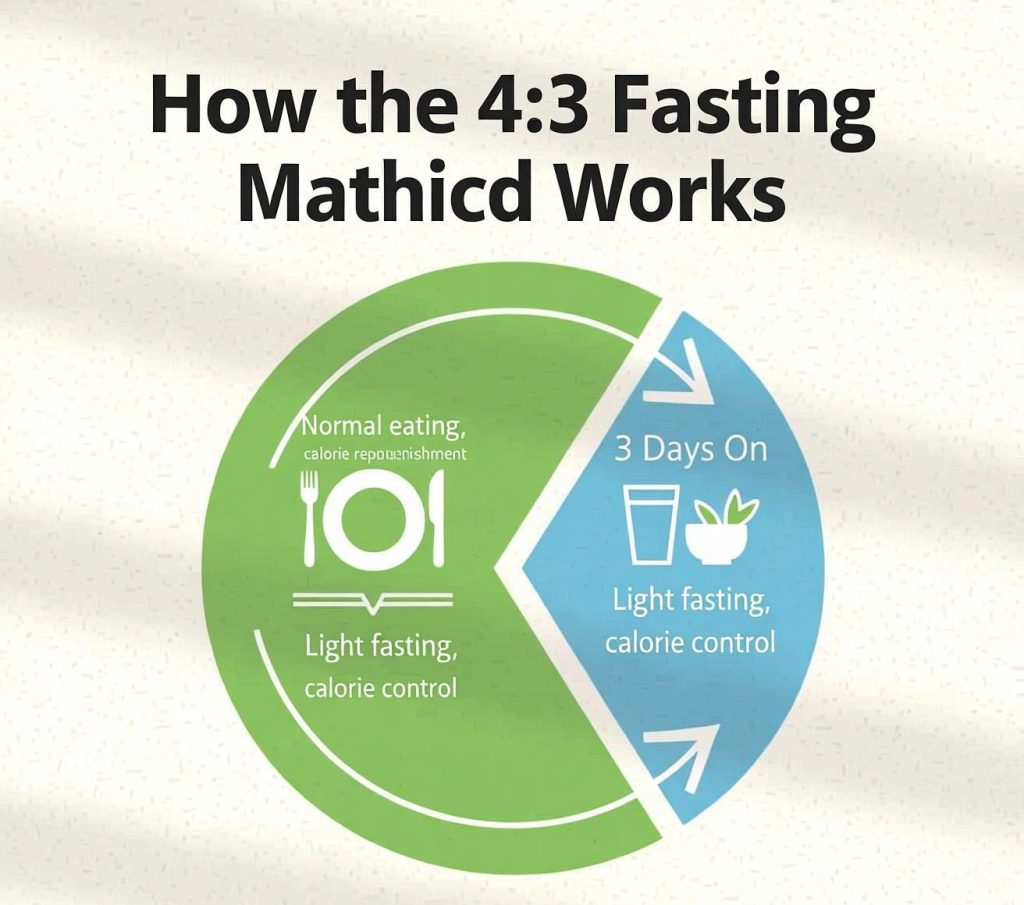
The 4:3 fasting method is a weekly intermittent fasting pattern in which you eat normally for four days and restrict calories to roughly 20–25% of your needs on the other three non-consecutive days.
In a landmark 12-month randomized trial from the University of Colorado School of Medicine, this approach produced an average weight loss of 7.6% of body weight, outperforming traditional daily calorie restriction (5%) and showing better long-term adherence, with only 19% dropout compared to 30% in the calorie-counting group.
Below is a complete breakdown of how the method works, what the science actually shows, how it compares to other fasting protocols, and who should think twice before starting.
What Exactly Is the 4:3 Fasting Method?
The 4:3 method belongs to the family of “whole-day” intermittent fasting protocols, sometimes called intermittent energy restriction. Unlike time-restricted eating (such as 16:8), which limits when you eat each day, the 4:3 method limits which days you restrict intake.
The mechanics are straightforward:
- 4 “off” days per week: You eat your normal diet with no calorie counting, though researchers emphasized healthy foods and sensible portions.
- 3 “fast” days per week: You consume about 20% of your typical energy needs — roughly 400–600 calories per day for women and 500–700 for men, based on individual resting metabolic rate.
- Non-consecutive spacing: Fast days should not be back-to-back. A common arrangement is Monday, Wednesday, and Friday, which gives your body a full recovery day between each restriction.
Because the three fast days create an 80% deficit on those days, the math averages out to roughly a 34% weekly calorie deficit — the same target researchers assigned to the daily calorie restriction comparison group. This design matters, because it lets scientists isolate whether the pattern of restriction offers any advantage over the amount of restriction.
What the 12-Month Head-to-Head Study Found?
The most credible evidence for the 4:3 method comes from a study published in Annals of Internal Medicine by Catenacci and colleagues, which followed 165 adults with overweight or obesity for a full year.
Both groups received identical behavioral support: weekly group meetings with a registered dietitian for the first 12 weeks, biweekly meetings thereafter, a free gym membership, and a target of 300 minutes of exercise weekly.
The key findings at 12 months:
| Outcome | 4:3 Fasting Group | Daily Calorie Restriction Group |
|---|---|---|
| Average weight loss | 7.6% of body weight | 5.0% of body weight |
| Lost at least 5% of body weight | 58% of participants | 47% of participants |
| Dropout rate at 12 months | 19% | 30% |
| Designed weekly calorie deficit | ~34% | ~34% |
Using doubly labeled water — a gold-standard isotope method for measuring real-world energy expenditure — the researchers confirmed that the fasting group actually restricted calories more than the calorie-counting group did, indicating better adherence rather than a metabolic magic trick.
Secondary measures also hinted at favorable shifts in systolic blood pressure, total cholesterol, fasting glucose, and hemoglobin A1C, though the study was not powered to make definitive cardiometabolic claims.
Not everyone in the field is ready to crown a winner. Dr. Mir Ali, a bariatric surgeon not involved in the research, described the 4:3 advantage as “modest at best” and noted that no single method works for everyone.
Registered dietitian Monique Richard suggested the pattern may act like “metabolic confusion” — oscillating between deficit and sufficiency — but stressed that success is highly individual and depends on medication use, mood, and social context.
Why Three Days Might Be the “Sweet Spot”?
Researchers deliberately chose three fast days after reviewing earlier trials. Two-day protocols (like 5:2) often failed to produce enough of a deficit to beat daily restriction, while alternate-day fasting proved too rigid for long-term adherence. Three flexible days per week landed in a middle ground: enough deficit to matter, enough freedom to sustain.
From a behavioral psychology standpoint, the advantage may be cognitive rather than metabolic. Counting calories every single day creates decision fatigue and constant self-monitoring, which many people find exhausting.
With 4:3, you only “diet” three days a week, and the other four require no arithmetic at all. This reduces the psychological burden that typically causes diet abandonment.
From a metabolic perspective, fasting days may trigger transient changes in insulin signaling, fat oxidation, and hunger hormones like ghrelin and leptin. The Colorado team is currently analyzing blood and stool samples to explore whether fasting periods confer independent benefits beyond the calorie deficit itself — including effects on the gut microbiome.
Notably, a 2025 meta-analysis ranked alternate-day and modified fasting protocols among the most effective regimens for weight loss compared with 5:2 and time-restricted eating, though the authors cautioned that the underlying mechanisms remain unclear.
A more skeptical clinical view, echoed by outside experts, reminds us that the weight-loss difference between groups was about 2.6 percentage points — meaningful, but not transformative. Reward-based eating scores decreased in both groups over the year, suggesting that structured support, not the fasting pattern alone, drove much of the behavioral change.
How the 4:3 Method Compares to Other Fasting Protocols
If you’re weighing your options, the table below summarizes how 4:3 stacks up against the two most popular alternatives.
| Feature | 4:3 Fasting | 5:2 Diet | 16:8 Time-Restricted Eating |
|---|---|---|---|
| Structure | Eat normally 4 days; restrict ~20% of needs on 3 non-consecutive days | Eat normally 5 days; restrict ~25% of needs on 2 days | Fast 16 hours daily; eat within an 8-hour window |
| Typical weekly deficit | ~34% | ~20–25% | Variable, often 10–20% |
| Daily calorie counting | Only on fast days | Only on fast days | None (clock-based) |
| Social flexibility | Moderate — 4 unrestricted days | High — 5 unrestricted days | Low — daily window constraint |
| Best suited for | People wanting faster results who can handle 3 restrictive days | Beginners or those who find 3 fast days too demanding | People who prefer a daily routine over whole-day fasts |
| Key limitation | Hard days require planning and discipline | Smaller deficit, slower results | Doesn’t work well for late-night eaters or shift workers |
The 12-month trial data support the idea that 4:3’s larger weekly deficit gives it an edge over 5:2, while its flexibility gives it an edge over strict daily restriction.
How to Start: A Practical First-Week Plan
Dietitians recommend easing in rather than jumping straight into full 24-hour restrictions. Here’s a gradual on-ramp modeled on advice from registered dietitians commenting on the research:
- Days 1–7: Eat normally and simply observe your hunger patterns. Note which days of the week are most socially flexible for you.
- Week 2: Try one 24-hour restriction day (eating ~20% of your normal calories). See how your energy, mood, and concentration respond.
- Week 3: Add a second restriction day, separated by at least one normal eating day.
- Week 4 onward: Add the third restriction day. Your schedule might look like fasting Monday, Wednesday, and Friday, with normal eating Tuesday, Thursday, Saturday, and Sunday.
On fast days, prioritize protein and fiber to blunt hunger — think vegetable soups, Greek yogurt, eggs, lean poultry, leafy greens, and plenty of water, black coffee, or unsweetened tea.
On the four unrestricted days, the study protocol emphasized whole foods and reasonable portions rather than unlimited junk; treating them as “cheat days” undermines the weekly deficit and was explicitly discouraged by the researchers.
Who Should Avoid the 4:3 Method
Despite promising results, 4:3 fasting is not appropriate for everyone. Clinical guidance on whole-day fasting protocols consistently flags the following groups:
- People with diabetes (especially type 1) or a history of hypoglycemia
- Anyone who is underweight or has a history of eating disorders
- Pregnant or breastfeeding women
- Children and teenagers
- People taking medications that require consistent food intake, such as insulin, sulfonylureas, or certain blood pressure drugs
- Older adults at risk of muscle loss and malnutrition
- Individuals with cancer or cardiovascular disease, pending medical clearance — the Colorado researchers themselves noted these populations have not yet been studied
Even for healthy adults, the transition can bring headaches, irritability, fatigue, and difficulty concentrating during the first two to three weeks.
Dietitian Monique Richard recommends asking yourself honestly whether you become “hangry” after six to eight hours without food, and whether the schedule will conflict with family dinners, celebrations, or work demands — factors that can breed resentment or trigger disordered eating patterns in vulnerable individuals.
Consulting a registered dietitian nutritionist before starting remains the safest route, particularly if you take prescription medications.
Can I Exercise on Fasting Days?
Yes, but with adjustments. The Colorado study gave all participants a gym membership and encouraged 300 minutes of weekly activity, and many participants did train on or around fast days.
That said, planning matters: schedule intense workouts (heavy lifting, HIIT, long runs) on your four unrestricted days when glycogen stores are full, and save light movement — walking, stretching, easy cycling — for fast days.
Timing a workout shortly before your single fast-day meal can also make recovery easier. If you feel dizzy, shaky, or unusually weak, stop and eat; that signal matters more than any workout plan.
Will the 4:3 Method Slow Down My Metabolism?
This is one of the most common concerns, and the available evidence is reassuring. Because the four unrestricted days periodically restore normal energy intake, the body receives regular signals that food is available, which may attenuate the adaptive thermogenesis (metabolic slowdown) often seen with continuous dieting.
Resting energy expenditure was measured at baseline in the trial, and the fasting group maintained better adherence without the plateau patterns frequently reported in daily restriction.
The “metabolic confusion” hypothesis — that alternating deficit and sufficiency keeps the metabolism responsive — has some support, though dietitian Monique Richard cautioned that the science is still limited and individual results vary widely.
What matters most for long-term metabolic health is preserving lean muscle through adequate protein intake and resistance training, regardless of which fasting schedule you follow.
What Can I Eat and Drink on Fast Days?
On fast days you’re targeting roughly 20% of your normal calorie needs — typically 400–600 calories for women and 500–700 for men, individualized to your measured resting metabolic rate. Water, black coffee, unsweetened tea, and other zero-calorie beverages are unlimited.
For food, build meals around high-volume, high-protein, high-fiber options that maximize satiety per calorie: vegetable-heavy soups and stews, plain Greek yogurt, eggs, cottage cheese, lean fish or poultry, tofu, legumes, and generous portions of non-starchy vegetables.
Spreading your allowance across two small meals (for example, midday and evening) tends to be more sustainable than a single meal for most beginners. Alcohol, sugary drinks, and refined snacks offer poor satiety per calorie and are best avoided on fast days.
How Is 4:3 Different From the 5:2 Diet?
Both are whole-day fasting protocols, but they differ in one crucial number. The 5:2 diet restricts calories on two days per week, while 4:3 adds a third restriction day.
That extra day pushes the weekly deficit from roughly 20–25% up to about 34%, which is why the Colorado team designed their study around 4:3 — earlier 5:2 trials consistently failed to beat daily calorie restriction because the deficit was too small.
The tradeoff is straightforward: 5:2 is easier to fit around social life and requires less discipline, while 4:3 demands more weekly commitment but produced measurably greater weight loss and better adherence than daily dieting in the head-to-head trial.
Think of 5:2 as the entry point and 4:3 as the next step for people who have successfully adapted to two fast days and want more momentum.
How Long Until I See Results on the 4:3 Method?
In the 12-month trial, participants met weekly with a dietitian for the first 12 weeks, and meaningful weight changes typically emerged within the first two to three months — the same window where most people notice clothing fitting differently and energy improving.
A realistic expectation is 1–2 pounds per week during the initial phase, tapering to 0.5–1 pound per week as your body adapts. The clinically meaningful benchmark used in the study was a 5% reduction in body weight, associated with improvements in blood pressure, glucose, and hemoglobin A1C; 58% of the 4:3 group hit that mark within a year.
If your weight stalls for three to four weeks, the usual culprits are creeping portions on unrestricted days, underestimating fast-day intake, or reduced spontaneous activity — tracking both for one week usually reveals the leak.
Key Takeaways
The 4:3 fasting method is a flexible, evidence-supported alternative to daily calorie counting that restricts intake on three non-consecutive days per week while allowing normal eating on the other four.
Its main advantage, according to the strongest available trial, is not a metabolic loophole but superior adherence — people simply find it easier to stick with than counting calories every day, and better adherence translated into greater 12-month weight loss and lower dropout.
It is not suitable for everyone, particularly those with diabetes, eating disorder history, pregnancy, or medications requiring consistent food intake.
Used thoughtfully, with protein-prioritized fast days, sensible portions on unrestricted days, regular movement, and professional guidance where appropriate, it sits within the range of legitimate evidence-based tools for weight management rather than a miracle fix.