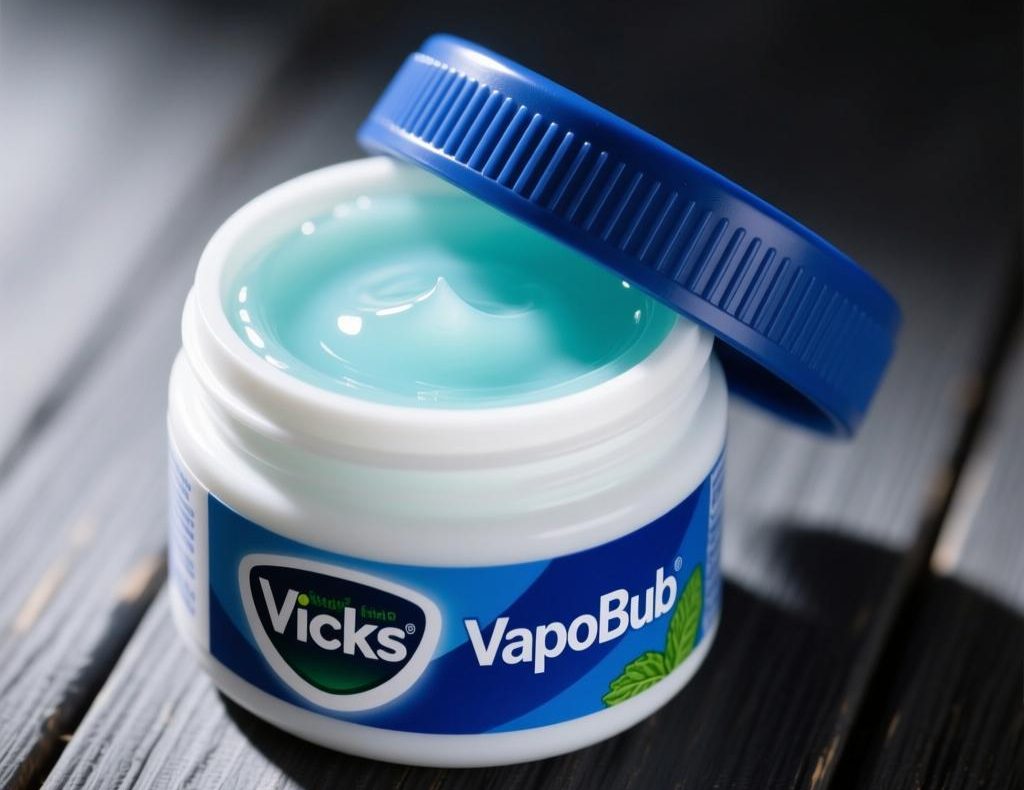
Few health rumors illustrate the power of social media quite like the claim that Vicks VapoRub—an ordinary mentholated chest rub found in medicine cabinets around the world—can treat erectile dysfunction.
The story circulates in short videos and forwarded messages describing men applying the ointment to the genital area before sex, reporting a warming, tingling sensation and, supposedly, improved performance.
To an experienced clinician, the claim is immediately implausible, but its popularity deserves a serious explanation rather than a dismissive laugh.
What Is Actually in Vicks VapoRub and What Those Ingredients Can and Cannot Do?
Vicks VapoRub is an over-the-counter topical cough suppressant and topical analgesic. Its labeled uses are the relief of cough due to minor throat and bronchial irritation and the temporary relief of minor muscle and joint aches. The formulation includes:
- Menthol (about 2.6%) — activates TRPM8 cold receptors, producing a cooling sensation.
- Camphor (about 4.8%) — a counter-irritant producing mild warming; toxic if ingested and harmful on broken skin.
- Eucalyptus oil (about 1.2%) — aromatic, with mild sensory and inhaled decongestant effects.
- Petrolatum base — an occlusive petroleum jelly holding the actives against the skin.
- Turpentine and cedarleaf oils — traditional fragrant components.
Notice what is absent: any vasodilator. An erection is a hydraulic event driven by nitric oxide signaling, relaxation of smooth muscle inside the corpora cavernosa, arterial inflow, and compression of draining veins.
Nothing in Vicks touches any part of that sequence. Menthol and camphor act on sensory nerves in the surface of the skin; they do not open penile arteries, relax cavernosal smooth muscle, or influence the nitric oxide pathway that oral ED medications target.
The dramatic tingle is a message from skin temperature receptors to the brain—not increased blood flow, and certainly not an erection-producing mechanism.
It is worth stating the general principle plainly: sensation is not circulation. If strong skin sensations equaled improved erections, capsaicin cream, ice packs, and mustard plasters would all be sexual enhancers. They are not, and neither is Vicks.
Why Applying Vicks to Genital Skin Is a Bad Idea?
Even if the effectiveness question were somehow open, the safety question is not. Applying Vicks to the genital area is risky for several concrete reasons.
Enhanced absorption. Genital and groin skin is thinner, more permeable, and more vascular than skin on the arms or legs, and clothing creates occlusion that drives further absorption. Menthol and camphor reach the bloodstream faster from this region than from almost anywhere else.
Chemical irritation. Menthol and camphor are potent irritants on thin skin and mucous membranes. Men who have tried this describe burning, stinging, and redness lasting hours; contact dermatitis—with swelling and blistering—is a documented risk. On the glans or under the foreskin, the reaction can be genuinely painful.
Partner and condom issues. The ointment transfers during intercourse and can burn a partner’s tissue as well. The petrolatum base degrades latex, increasing the risk of condom failure and everything that follows from it—unplanned pregnancy and sexually transmitted infections.
Camphor toxicity. Although a single small adult application is unlikely to cause systemic poisoning, camphor is a recognized toxic substance in larger exposures, causing nausea, confusion, and neurological symptoms. Repeated application to highly absorbent skin is pointless risk.
Diagnostic delay—the quiet danger.
This is the risk most physicians worry about most. Erectile dysfunction is frequently the earliest visible sign of cardiovascular disease, often preceding heart attack or stroke by years, and it is also a common first presentation of diabetes or low testosterone.
A man who manages his ED with a tingly ointment is not just wasting time; he may be missing a window when a proper workup could detect serious, treatable disease.
The label itself restricts use to the chest, throat, back, and muscles, and explicitly warns against broken skin—the genitals violate both the approved sites and the spirit of every warning on the package.
What Are The Effective Treatments for ED?
The constructive answer to the myth is not merely “no,” but “here is what does work.” Modern sexual medicine can help the overwhelming majority of men with ED.
- Oral PDE5 inhibitors. Sildenafil (Viagra), tadalafil (Cialis), vardenafil (Levitra), and avanafil (Stendra) are first-line therapy for most men. They protect cyclic GMP—the chemical messenger of erection—from breakdown, amplifying natural arousal signals. They succeed in roughly 70 to 80 percent of cases across causes. They require sexual stimulation, must never be combined with nitrates such as nitroglycerin, and should be prescribed after a cardiovascular screen.
- Lifestyle modification. This is a genuine treatment, not a platitude. Regular aerobic exercise improves erectile function through measurable endothelial benefits; modest weight loss in obese men produces significant improvement; smoking cessation restores function in many smokers; limiting alcohol, treating sleep apnea, and managing stress all contribute. For lifestyle-driven ED, these changes rival medication—and they protect the heart at the same time.
- Treating underlying disease. Correcting blood sugar, blood pressure, lipids, and testosterone (when genuinely low) addresses ED at the root. Sometimes the fix is as simple as switching a medication—certain antidepressants and blood pressure drugs are common culprits.
- Psychological therapy. Where anxiety, depression, or relationship conflict dominate—especially in younger men—sex therapy and cognitive behavioral therapy have strong evidence, and combined medication-plus-therapy approaches often outperform either alone.
Second- and third-line options. Vacuum erection devices, alprostadil injections, intraurethral suppositories, low-intensity shockwave therapy (an emerging option aimed at stimulating new vessel growth), and penile implants round out the arsenal.
Between these approaches, virtually every man with ED can be treated successfully. There is no rational reason to experiment with a cough rub.
Frequently Asked Questions
1. Does Vicks VapoRub improve blood flow to the penis?
No. The tingling and cooling come from menthol and camphor activating temperature-sensing nerve receptors in the skin—a perception, not a hemodynamic event.
Counter-irritants do not dilate the deep penile arteries that must open for an erection, and no study has ever demonstrated increased penile blood flow after Vicks application. The “activity” you feel under the skin is your nervous system reporting a chemical sensation, not your circulation improving.
2. Is it dangerous to put Vicks on my genitals?
Yes, and it is not an approved use of the product. Genital skin is thin and highly absorbent, so menthol and camphor penetrate faster and can cause burning, stinging, redness, and sometimes blistering contact dermatitis.
Contact with the urethral opening can cause intense pain, the product can transfer to a partner during sex, and its petroleum base degrades latex condoms, raising the risk of breakage.
Larger or repeated exposures raise theoretical camphor toxicity concerns. The manufacturer’s label limits use to the chest, throat, back, and muscles—the genitals are explicitly outside safe territory.
3. Some men online say it worked for them—could the placebo effect be real?
The improvement they feel can be real, but it is not caused by the ointment. Erections depend heavily on the brain, and placebo response rates in ED trials run 25 to 40 percent. Confidence and reduced performance anxiety alone can restore function in men whose ED is psychological.
The problems are that this effect is unreliable, does nothing for vascular, nerve, or hormonal causes, and can delay diagnosis of serious underlying disease such as diabetes or coronary artery disease. Believing an anecdote is understandable; building a treatment plan on one is not.
4. I already applied Vicks and now have burning and irritation—what should I do?
Gently wash the area with lukewarm water and mild soap; do not scrub, and do not layer other ointments or home remedies on top. Mild irritant reactions usually settle within hours to a few days.
Seek medical care promptly if you have severe or worsening pain, blistering, swelling that interferes with urination, spreading redness or pus suggesting infection, or symptoms persisting beyond two or three days.
Tell the clinician exactly what you applied and when. Then bring the underlying issue—your ED—to the same visit rather than experimenting further.
5. If topical ED treatments exist, why isn’t Vicks one of them?
Because genuine topical treatments work through entirely different mechanisms. Alprostadil cream and injection contain a proven vasodilator that directly relaxes penile blood vessel smooth muscle, increasing arterial inflow—and it was tested in clinical trials before approval.
Vicks contains no vasodilator; its ingredients merely trigger temperature sensations in skin nerves. The difference is the difference between a key that fits a lock and a noise that resembles a key. Producing strong sensations on the skin does not make a substance a medicine for the structures beneath it.
Closing Thoughts
The Vicks VapoRub erectile dysfunction myth is a near-perfect case study in how health misinformation forms: a genuine sensation mistaken for a genuine effect, amplified by engagement-driven algorithms, sustained by placebo and selective storytelling, and left unchallenged because the subject is too embarrassing for many men to verify with a professional.It deserves neither mockery nor panic—only correction, delivered with the empathy that the embarrassment demands.
If this article leaves you with one principle, let it be this: sensations are not treatments, testimonials are not trials, and a jar of cough rub is not a doctor. Ask the question out loud. It may be the most important health decision you make this year.